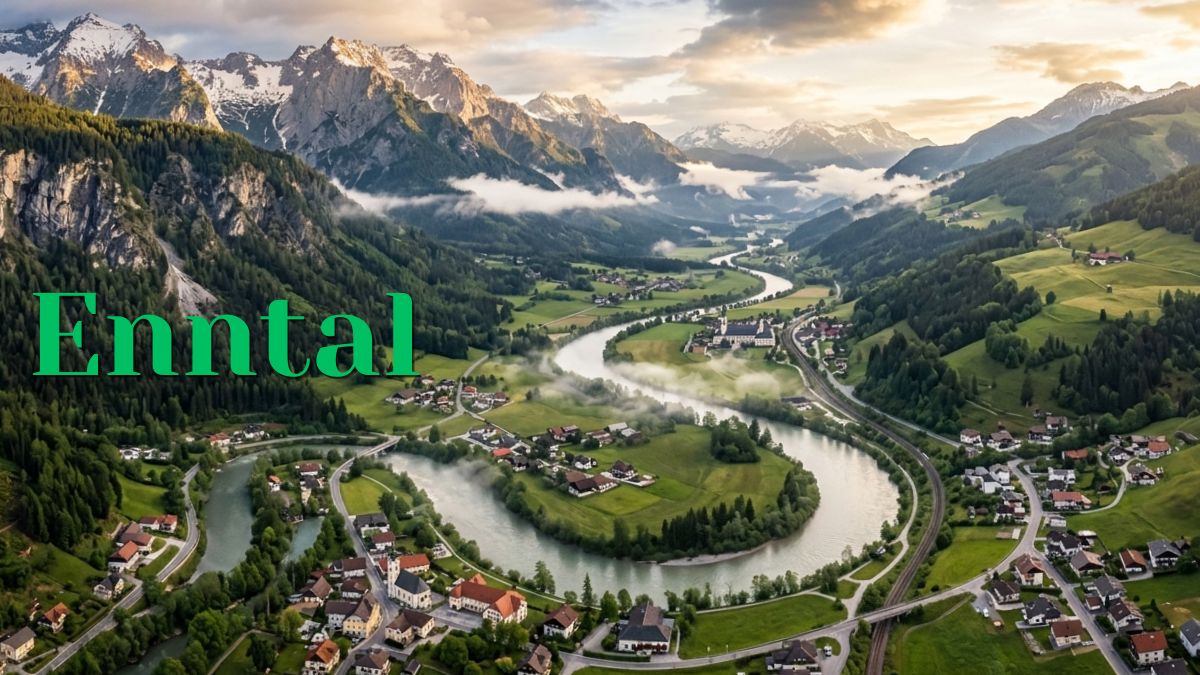
If you’ve spent any time researching Austria travel, you already know the drill: Hallstatt gets flooded with selfie sticks by 9 AM, Innsbruck’s Old Town is a carousel of tour groups, and even “off-season” Tyrol feels crowded. But there’s a valley that sits quietly between Styria and Upper Austria, threading the Enns River through limestone peaks and green meadows, that most travelers drive straight through without stopping.
That valley is Enntal, and it might just be the smartest Austria decision you make.
This isn’t a “you’ve never heard of it” piece. Enntal (also written as Ennstal in German, meaning simply Enns Valley) spans a well-connected corridor served by the Ennstalbahn railway and the B320 highway. But connected doesn’t mean overcrowded. That distinction is exactly why experienced slow travelers are quietly making Enntal their Austrian base of choice in 2025 and 2026.
What Is Enntal?
Enntal is a long, river-carved valley in the heart of Austria, shaped over millennia by the steady flow of the Enns River as it winds eastward through the Eastern Alps. It isn’t a single town or a pinpoint on a map it’s an entire living corridor stretching across the federal states of Styria and Upper Austria, connecting alpine meadows, limestone gorges, historic market towns, and forested hillsides in one continuous sweep of landscape.
The river originates near the Radstädter Tauern mountains, flows east through the ski hub of Schladming, narrows dramatically through Gesäuse National Park, and eventually joins the Danube near the historically significant town of Enns.
Key towns along the valley include:
- Schladming is internationally known for alpine skiing and the FIS Night Race
- Ramsau am Dachstein is a sunny plateau beneath the Dachstein glacier
- Admont is home to the world’s largest monastic library at Admont Abbey
- Liezen is a practical regional hub with connections to the side valleys
- Steyr is a well-preserved medieval town at the valley’s eastern end
Elevations shift from around 300 meters on the valley floor to over 2,000 meters in the surrounding ranges, the Dachstein Massif to the north and the Schladminger Tauern to the south. That vertical range means the valley genuinely delivers year-round variety without needing to artificially reinvent itself for seasonal tourism.
Enntal vs. Other Austrian Destinations
Here’s what most Austrian travel content won’t tell you directly:
| Feature | Enntal | Hallstatt | Tyrol/Innsbruck |
|---|---|---|---|
| Crowd levels | Low to moderate | Extremely high (peak season) | High |
| Budget-friendliness | High – family Gasthöfe, free hiking | Lower – limited accommodation | Moderate to high |
| Authenticity | Strong – towns exist for locals | Low – heavily tourism-dependent | Mixed |
| Seasonal variety | All four seasons | Best spring/summer | Winter-dominant |
| Rail access | Good (Ennstalbahn) | Limited, requires planning | Excellent |
| Child-friendliness | Very high | Moderate | High |
| Cultural depth | Abbey, Roman history, folk festivals | Salt mine, UNESCO status | Museums, Golden Roof |
Hallstatt is a single, photogenic lakeside village, remarkable, yes, but essentially a day-trip destination now managed by crowd-control ticketing systems. Enntal is an entire valley ecosystem where the communities still exist primarily for the people who live there. Shops serve locals first. Cafés aren’t curated for tourists. That distinction matters more than any Instagram metric.
The 4 Reasons Experienced Travelers Choose Enntal
1. Space to Breathe — Literally and Figuratively
The mountains in Enntal don’t dominate you the way the narrow gorges of more famous Alpine valleys do. They frame the horizon patiently. The Gesäuse National Park east of Admont is one of Austria’s wildest protected areas, home to golden eagles, chamois, and lynx, yet it receives a fraction of the visitors that Hallstatt’s car parks process on a Saturday morning. The park’s limestone walls drop into river gorges, creating terrain that genuinely rewards those willing to seek it out.
2. A Cultural Anchor Most Travelers Miss
Admont Abbey (Stift Admont) houses what is widely cited as the world’s largest monastic library, an 18th-century Baroque hall containing over 70,000 volumes under frescoed ceilings. It’s extraordinary by any global standard, yet you can visit on a Tuesday morning with room to stand and actually think. Compare that to the queues at Vienna’s Kunsthistorisches Museum and the value becomes obvious.
The town of Enns itself holds the distinction of being Austria’s oldest chartered municipality, dating its charter to 1212. Roman military presence here, at the camp of Lauriacum, goes back to 15 AD. Settlements in the broader valley predate that by thousands of years. Celtic Noricum established roots here around 400 BC.
3. Year-Round Activity Without Seasonal Dead Zones
Unlike many alpine destinations that effectively shut down between ski season and hiking season, Enntal rotates naturally through four distinct modes:
- Spring (April–May): Wildflowers return to alpine meadows, waterfalls run strong from snowmelt, trails reopen, and the valley is nearly visitor-free.
- Summer (June–August): The Enns Cycle Path, mostly flat, passing through villages and riverside fields, is the star. Swimming holes, via ferrata routes, and Dachstein glacier walks all come online.
- Autumn (September–October): Photographers and hikers know this is Enntal’s best-kept secret season. Golden light, cooling temperatures, the Almabtrieb cattle drive festivals, and practically zero competition for trail space.
- Winter (November–March): Schladming’s Planai ski area delivers world-class downhill skiing. But the valley also offers Nordic skiing, snowshoeing, and winter hiking for those who find crowded ski resorts exhausting.
4. The Food Tells the Truth About a Place
Enntal’s cuisine is not trying to be anything. It’s Styrian food, honest, regional, and tied directly to what the valley produces. You will find:
- Enntaler Kaspressknödel, pan-fried cheese dumplings, golden and crisp, usually paired with sauerkraut
- Eintopf, a hearty slow-cooked stew with seasonal vegetables and local meat
- Pumpkin seed oil drizzled over fresh salads, a Styrian signature you won’t find replicated properly outside the region
- Hausgemachter Strudel, apple or berry strudel pulled from family ovens, not a factory kitchen
Seek out the small, family-run Gasthöfe (guesthouses) where recipes have been handed down across generations. The host who gives you real hiking advice, not a tourist brochure, usually also runs the kitchen.
How to Get to Enntal
Getting to Enntal is genuinely straightforward, which surprises many first-time visitors who expect remoteness to mean inaccessibility.
By rail: The Ennstalbahn connects Salzburg through Schladming and Liezen to Selzthal, where lines branch to Graz and Linz. From Salzburg, the western valley (Radstadt/Altenmarkt area) is roughly 80–100 km. From Graz, Schladming is about 150–180 km. Also, from Vienna, the eastern valley sits around 230–260 km.
By car: The B320/E651 highway is the main valley corridor. Road conditions in winter require checking, but the route is well-maintained.
Nearest airports: Salzburg (SZG) and Graz (GRZ) are the closest international gateways. Vienna (VIE) works for the eastern sections.
A car helps for reaching remote trailheads and farm stays, particularly in shoulder seasons when some bus services reduce frequency. But the core valley is navigable without one.
Where to Stay in Enntal
Forget international hotel chains. Enntal is the territory of the Gasthof and Bauernhof (farm stay). These aren’t rustic compromises; they’re the actual point of visiting. Expect:
- Breakfasts with homemade jams, local cheeses, and bread baked that morning
- Hosts who know every trail and will tell you which ones to avoid after rain
- Nights are quiet enough to hear the Enns River moving
For those preferring more amenities, Schladming has a solid range of hotels suited to ski-season demand, and several Therme (thermal spa) facilities in the broader region offer wellness infrastructure without the price tags of Tyrol’s resort towns.
Practical Travel Tips Most Guides Skip
- Visit Admont Abbey on a weekday morning, even in summer, weekend afternoons bring small group tours that break the silence of the library hall.
- The Enns Cycle Path is underrated for non-cyclists. The flat riverside sections are ideal for families with young children or anyone who simply wants to walk without elevation.
- Underground caves in the valley guided tours through cave systems offer a geological dimension rarely covered in standard Austria itineraries.
- Budget significantly lower than Tyrol accommodation in family-run guesthouses often runs 30–40% less than comparable comfort in Innsbruck or Kitzbühel.
- Late September is the Almabtrieb season, when decorated cattle descend from high pastures to the valley in traditional festivals that are genuine community events, not staged tourism.
Also read: Connecting Through Nature: How Outdoor Activities Strengthen Relationships
Who Should Choose Enntal (And Who Shouldn’t)
Enntal works well for you if:
- You value calm over crowds and presence over performance
- You want authentic Austrian small-town life, not a tourism performance
- You enjoy hiking, cycling, or simply reading by a river
- You’re traveling with family and want safety, space, and affordability
- You’re a photographer who prefers empty landscapes to selfie queues
- You want cultural depth, history, monasteries, and regional food without fighting for it
Enntal is probably not the right fit if:
- You need nightlife, designer shopping, or constant structured entertainment
- Your trip is about ticking famous landmarks off a list every day
- You want the guarantee of a packed calendar of organized tourist activities
Conclusion
Austria has no shortage of beautiful places. But “beautiful and famous” and “beautiful and worth it” are not always the same thing. Enntal sits firmly in the second category. It doesn’t perform for tourists. It doesn’t need to. The Dachstein glacier is just as dramatic, the food is just as honest, the history is just as deep, and you can actually experience all of it without a crowd blocking your view.
The valley has been passed through for centuries. Celts, Romans, medieval merchants, and railway builders all moved through without stopping long enough. Now is a good time to stop.
FAQs About Enntal
What is Enntal and where is it located?
Enntal (also called Ennstal) is an alpine valley in central Austria following the Enns River through Styria and Upper Austria, stretching from near Radstadt in the west toward the Danube in the east.
How does Enntal compare to Hallstatt?
Hallstatt is a famous, overcrowded lakeside village; Enntal is an entire valley with multiple towns, national parks, and a fraction of the visitor pressure and significantly more affordable.
What is the best time to visit Enntal?
Late spring (May–June) and early autumn (September–October) offer ideal conditions, mild temperatures, fewer visitors, and stunning natural color, but all four seasons offer distinct appeal.
Is Enntal good for families?
Yes. The flat Enns Cycle Path, farm stays with animals, gentle walking trails, and welcoming local guesthouses make it one of Austria’s most genuinely family-friendly valley destinations.
What is Admont Abbey, and is it worth visiting?
Admont Abbey contains the world’s largest monastic library, a breathtaking Baroque hall with over 70,000 volumes, and it is absolutely worth the visit, especially midweek when it’s quiet.
Can I visit Enntal without a car?
The Ennstalbahn rail line covers the main valley towns. A car helps for remote trailheads and farm stays, but is not strictly necessary for a core Enntal experience.
Is Enntal expensive?
No. It is notably more affordable than Tyrol, Salzburgerland, or Hallstatt, with family-run accommodation, free hiking, and regional food at honest prices.