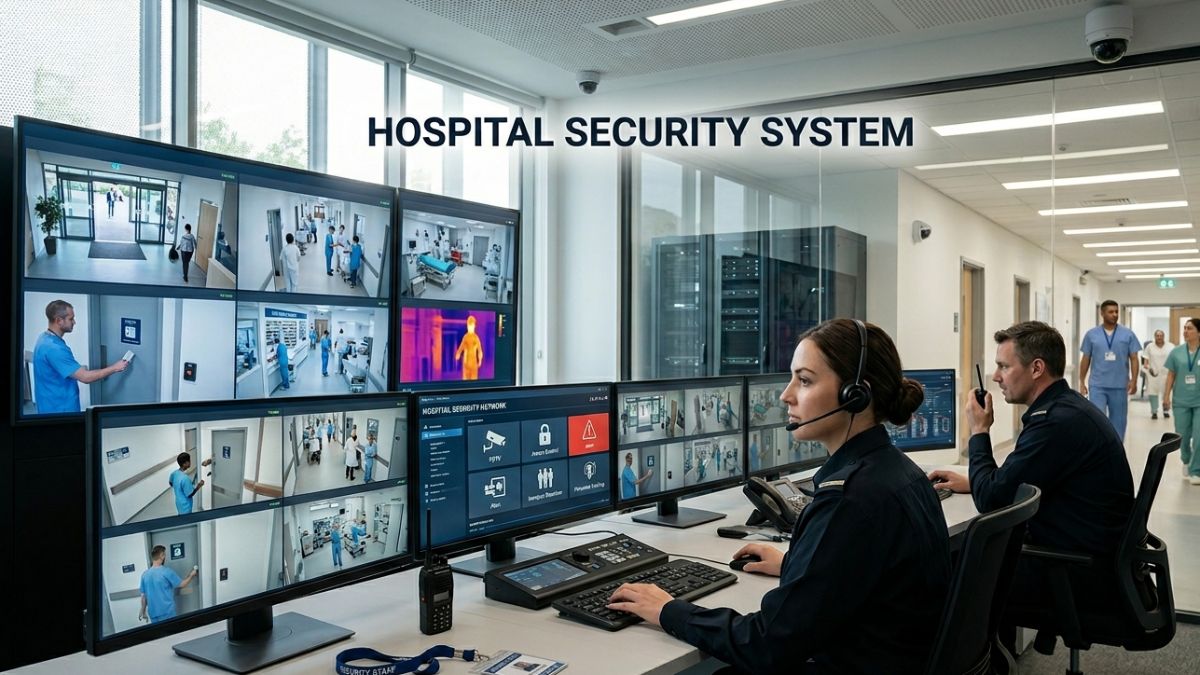
Hospitals are one of the most sensitive and high-risk environments when it comes to security. They operate around the clock, manage critical patients, store expensive equipment, and handle restricted areas that require strict access control. From emergency rooms to ICUs and pharmacies, every section of a hospital needs to be monitored carefully.
The scale of the challenge is significant. Healthcare facilities face rising incidents of workplace violence, unauthorized access, and theft. At the same time, relying on traditional surveillance is no longer enough. Studies show that operators monitoring video feeds can miss up to 95% of critical events after just 20 minutes, which creates serious gaps in real-time awareness.
This is where modern hospital security systems come into play.
Instead of just recording footage, today’s systems use AI, real-time alerts, and integrated technologies to actively monitor and protect hospital environments. They help security teams detect risks early, respond faster, and maintain a safer space for patients, staff, and visitors.
In this article, we break down the 7 must-have features every hospital security system should include and why they are critical for modern healthcare facilities.
Image source
1. Real-Time Video Monitoring with Intelligent Alerts
The foundation of any hospital security system is video surveillance, but basic recording is no longer enough.
Modern systems must provide real-time monitoring combined with intelligent alerts.
This means the system should not just capture footage but actively analyze it to detect:
- Unauthorized access to restricted areas
- Suspicious movement in hallways or waiting areas
- Patient falls or unusual behavior
- Loitering near sensitive zones
For example, a patient collapsing in a corridor should trigger an immediate alert instead of being discovered later.
This is where a modern hospital security system becomes critical. Solutions like Coram work with existing IP cameras and provide high-definition video along with intelligent alerts. They integrate seamlessly with access control systems and environmental sensors, allowing hospitals to monitor activity and respond to incidents without replacing their entire infrastructure.
Real-time visibility ensures that staff can act within seconds, which is essential in a healthcare setting.
2. Advanced Access Control for Restricted Areas
Hospitals have multiple high-security zones, including:
- Intensive Care Units (ICUs)
- Operating rooms
- Pharmacies
- Data centers
- Staff-only areas
Unauthorized access to these areas can compromise patient safety and data privacy.
A strong security system must include advanced access control that:
- Restricts entry based on roles
- Tracks who enter and exit
- Detects tailgating incidents
- Alerts staff during unauthorized access attempts
For example, if a door to a restricted ward is opened, the system should verify whether the person entering is authorized.
Access control systems become even more powerful when combined with video verification. This ensures that every access event is visually validated.
This feature helps hospitals maintain strict control over sensitive areas while ensuring smooth operations for authorized staff.
3. AI-Powered Video Analytics for Behavior Detection
Hospitals are complex environments where risks are not always obvious.
AI-powered video analytics helps identify patterns and behaviors that may indicate potential threats.
This includes detecting:
- Aggressive behavior in waiting areas
- Unusual movement in restricted zones
- Patients wandering into unsafe areas
- Suspicious activity near medication storage
Unlike traditional systems, AI can understand context.
For example:
- A nurse walking through a corridor is normal
- A visitor repeatedly entering a restricted area is suspicious
This ability to differentiate between normal and abnormal behavior is what makes AI essential.
It reduces false alarms and ensures that security teams focus only on meaningful alerts.
4. Integration with Environmental Sensors
Hospital safety is not limited to physical security.
Environmental factors also play a critical role.
A modern hospital security system should integrate with sensors that monitor:
- Temperature
- Smoke and fire
- Air quality
- Equipment conditions
For example:
- A sudden temperature rise in a storage room can damage medical supplies
- Smoke detection can trigger immediate evacuation protocols
By integrating environmental data with video surveillance, hospitals gain a more comprehensive safety system.
This ensures that both human and environmental risks are managed effectively.
5. Centralized Monitoring Across the Entire Facility
Hospitals are large and complex, often consisting of multiple buildings and departments.
Managing security across all these areas can be challenging.
A centralized monitoring system allows:
- Viewing all camera feeds in one place
- Managing alerts from a single dashboard
- Coordinating security teams efficiently
This improves response time and ensures that no area is overlooked.
For example, if an incident occurs in the emergency department, the central system can alert relevant teams instantly.
Centralized visibility is essential for maintaining consistent security across the entire hospital.
6. Fast and Intelligent Video Search
When incidents occur, hospitals need to investigate quickly.
Traditional systems require manual review of hours of footage, which is inefficient.
Modern systems offer intelligent video search capabilities.
This allows staff to:
- Search footage by time and location
- Filter by specific events or activities
- Quickly locate relevant video clips
For example:
- “Patient fell in the hallway at 2 PM.”
- “Unauthorized entry near ICU”
This feature significantly reduces investigation time.
It also helps improve reporting, compliance, and future safety planning.
7. Scalability and Easy Integration with Existing Infrastructure
Hospitals cannot afford to replace their entire security system every time technology evolves.
A good security system should be scalable and compatible with existing infrastructure.
This means:
- It should work with existing IP cameras
- It should support future expansion
- It should integrate with other systems, like access control
Quick setup is also important.
Hospitals need systems that can be deployed without disrupting daily operations.
A flexible and scalable system ensures long-term value and adaptability.
Key Takeaways
- Modern hospital security systems must go beyond basic surveillance
- Real-time monitoring and alerts are essential for quick response
- Access control protects sensitive areas and patient safety
- AI analytics helps detect risks and suspicious behavior
- Integration with sensors improves overall safety
- Centralized monitoring ensures better coordination
- Intelligent search speeds up investigations
- Scalability ensures long-term efficiency
FAQs
1. What is a hospital security system?
A hospital security system is a combination of surveillance, access control, and monitoring tools designed to protect patients, staff, and hospital assets.
2. Why are modern hospital security systems important?
They provide real-time monitoring, reduce risks, improve response time, and ensure patient safety in complex healthcare environments.
3. Can hospitals use existing cameras with new systems?
Yes. Many modern solutions work with existing IP cameras, allowing hospitals to upgrade without replacing hardware.
4. How does AI improve hospital security?
AI helps detect suspicious behavior, reduce false alarms, and provide actionable insights in real time.
5. What features should hospitals prioritize?
Hospitals should focus on real-time alerts, access control, AI analytics, centralized monitoring, and integration capabilities.
Conclusion
Hospital environments demand a higher level of security than most other industries.
With constant activity, sensitive areas, and critical patient care, even small security gaps can lead to serious consequences.
Modern hospital security systems address these challenges by combining AI, real-time monitoring, and integrated technologies. They help hospitals move from reactive security to proactive protection. And in healthcare, that shift can make all the difference.